
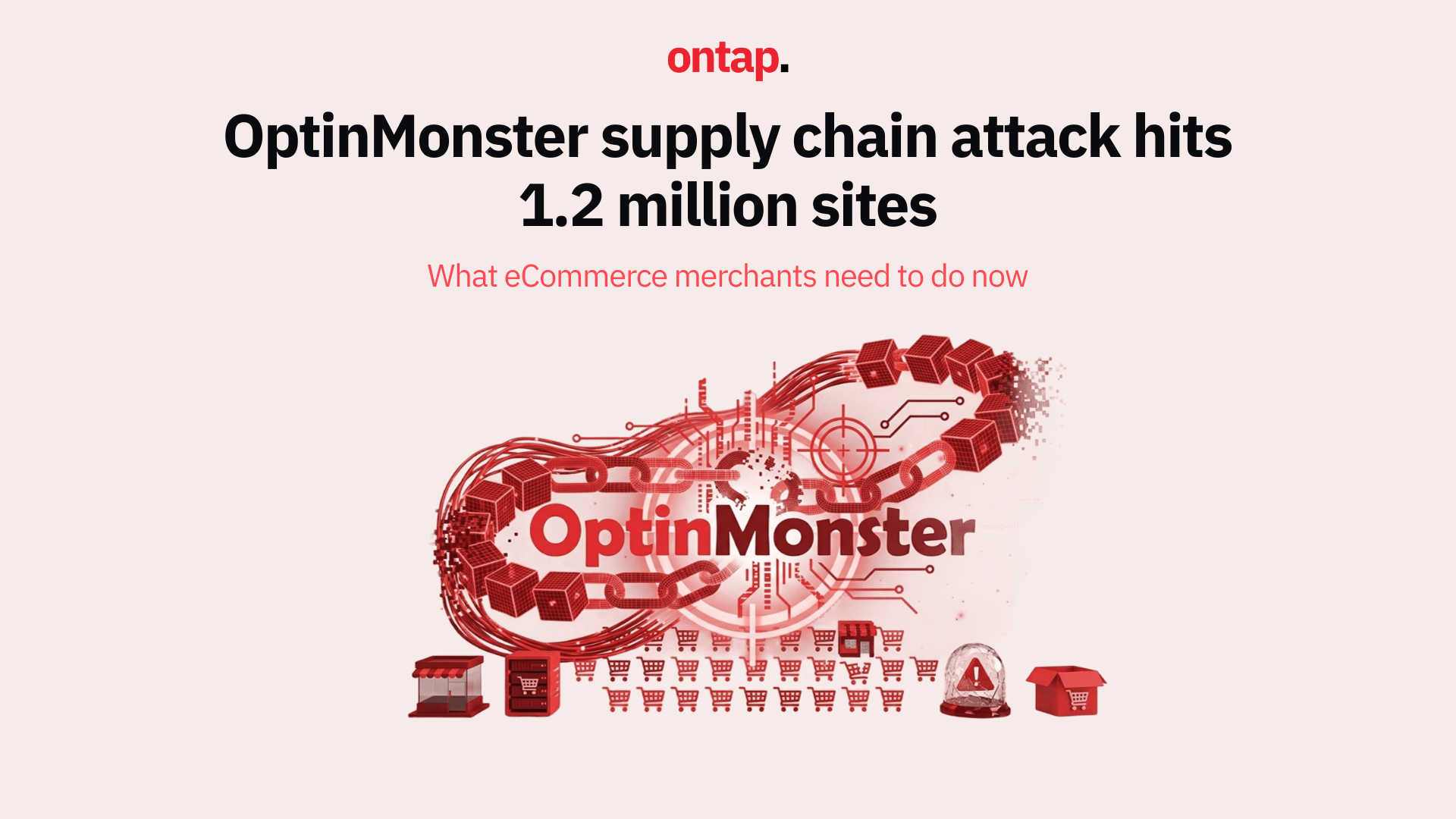
On 13 June 2026, eCommerce security firm Sansec disclosed one of the most significant supply chain attacks of the year: a coordinated compromise targeting OptinMonster, TrustPulse, and PushEngage, three widely used marketing and conversion tools that collectively serve over 1.2 million websites. The malware adds rogue admin accounts and plants hidden backdoors on affected sites.
This is not a theoretical vulnerability. It is an active attack, and if your store uses any of these tools, you need to act immediately.
What happened
As Sansec's threat research team reported, attackers compromised the CDN distribution infrastructure for OptinMonster and its sister products TrustPulse and PushEngage, all owned by Awesome Motive. According to Patchstack's independent analysis, the attackers exploited a vulnerability in the UpdraftPlus plugin running on Awesome Motive's marketing website, gained access to a CDN API key, and used it to modify the JavaScript files served to customers from the CDN edge.
The malicious code was injected into the tools' JavaScript assets, meaning any site loading these scripts was potentially exposed. The first verified injection appeared at 22:17 UTC on 12 June, with OptinMonster and TrustPulse CDN paths cleaned by 22:42 UTC. PushEngage continued serving injected code until 14 June, as reported by Bleeping Computer.
The attack is particularly insidious because it does not exploit a vulnerability in your store's core platform. Instead, it weaponises trusted third-party marketing tools that merchants willingly embed on their sites. When a logged-in administrator loaded a page, the compromised script executed silently, creating hidden administrator accounts and installing persistent backdoors that survive even if the original malicious script is later cleaned. Sansec noted that the backdoor plugin "actively hides from the user list, the plugin list, update checks, and the recently active list," rotating its disguise between "Content Delivery Helper" and "Database Optimiser" while keeping the malicious logic identical.
Why this matters for eCommerce
OptinMonster is one of the most popular lead generation and pop-up tools in eCommerce. It is used extensively across WooCommerce, Magento, and Shopify stores for email capture, exit-intent offers, and cart abandonment recovery. TrustPulse provides social proof notifications, and PushEngage handles web push notifications, all common tools in the conversion optimisation stack.
The attack surface is enormous. Unlike platform-level vulnerabilities that affect a specific CMS version, supply chain attacks on marketing tools cut across all platforms. A Magento store and a WooCommerce store running OptinMonster face the same risk, regardless of how well-maintained their core platforms are.
This also highlights a growing blind spot in eCommerce security posture. Most merchants focus their security efforts on platform patches, strong authentication, and PCI compliance. But every third-party script loaded on your storefront is a potential attack vector, and marketing teams often add these tools without security review.
Awesome Motive's broader portfolio is substantial. As Sansec noted, the company also operates WPForms (over 6 million active installs), MonsterInsights (around 2 million), and All in One SEO (around 3 million). Only OptinMonster, TrustPulse, and PushEngage have confirmed compromised code so far, but anyone running any Awesome Motive plugin should remain alert.
The expanding supply chain attack pattern
This is not an isolated incident. Earlier in 2026, Sansec uncovered a coordinated supply chain attack targeting 21 Magento extensions with backdoors hidden in their license verification code. Sansec itself drew the parallel to the Polyfill supply chain attack they discovered in 2024, noting: "Tamper with a single upstream file, and the malware reaches thousands of downstream sites without ever touching them individually."
The pattern is clear: attackers are systematically targeting the tools and dependencies that eCommerce sites rely on, rather than the core platforms themselves. It is easier, more scalable, and harder to detect.
What you should do right now
1. Audit your third-party scripts immediately. List every external JavaScript resource loaded on your storefront. If OptinMonster, TrustPulse, or PushEngage appear, assume compromise until proven otherwise.
2. Check for rogue admin accounts. Look specifically for developer_api1 ([email protected]) and any unexpected dev_xxxxxx accounts. Check directly in your database, as the backdoor actively hides from the admin dashboard.
3. Scan the filesystem, not just the UI. Inspect wp-content/plugins/ directly for content-delivery-helper or database-optimizer directories. The plugin hides from the WordPress dashboard, so trust the disk over the admin screen.
4. Scan for backdoors. If you are running Magento or WooCommerce, consider using Sansec's eComscan or similar forensic scanning tools to identify persistent backdoors.
5. Implement Content Security Policy (CSP) headers. CSP headers restrict which external domains can serve scripts on your site. While they will not retroactively fix a compromise, they make future supply chain attacks significantly harder to execute. As Threat-Modeling.com's analysis noted, Subresource Integrity (SRI) checks "could have prevented this attack entirely" by causing the browser to refuse execution of tampered CDN scripts.
6. Rotate everything if indicators are found. If you discover any rogue accounts or backdoor plugins, rotate all administrator passwords, API keys, database credentials, and WordPress security keys in wp-config.php. Assume the attackers obtained full administrative access.
7. Review your third-party risk process. This is the broader takeaway. Every script on your storefront is a trust decision. Marketing tools, analytics, A/B testing, chatbots: each one represents a vendor whose security practices directly affect your customers' data.
The bigger picture
For years, the eCommerce security conversation has centred on platform patches and PCI compliance. Those remain important, but supply chain attacks represent a fundamentally different threat model. You can run a perfectly patched, fully compliant store and still be compromised through a trusted marketing tool.
Your store's security is only as strong as the weakest script in your <head> tag. This incident, affecting 1.2 million sites through a single upstream CDN compromise, is the clearest demonstration yet that third-party script auditing belongs at the centre of every store's security posture, not as an afterthought.
About On Tap
On Tap is a growth-focused eCommerce consultancy helping mid-market and enterprise merchants build secure, high-performing stores. From third-party script auditing and CSP implementation to security reviews and incident response planning, On Tap helps merchants close the gap between their platform security and the third-party tools their businesses depend on.
If you are unsure whether your store is affected or needs help conducting a security audit, get in touch.